
Most SaaS startups don't fail because the idea was weak. They fail because the first version took 14 months to ship, ate the entire budget, and solved a problem users described differently than the founder imagined.
If you're planning to build a SaaS product in 2026, this guide covers the decisions that decide your outcome: what to build first, what it costs, which stack to pick, and how long it should take. Written for founders, not developers.
What SaaS Development Involves in 2026
SaaS development is the process of building a cloud-hosted software product that customers access through a subscription instead of buying and installing it. In practice, that means building four things at once: the product itself, the infrastructure it runs on, the billing and account system around it, and the security layer that keeps customer data safe.
That last part matters more in 2026 than it did even two years ago. Buyers now ask about data handling, AI usage policies, and compliance (SOC 2, GDPR, India's DPDP Act) before they ask about features. If you're selling to businesses, treat security as a feature from day one, because your first enterprise deal will stall on it otherwise.
The other shift: AI is now a baseline expectation, not a differentiator. Users assume your product will have intelligent search, summarisation, or automation somewhere. What differentiates you is whether the AI feature saves them time or just decorates the interface.
How Much Does SaaS Development Cost
For a startup working with a development partner, a realistic range in 2026 is $15,000 to $50,000 for an MVP, and $60,000 to $150,000+ for a full product with integrations, admin panels, and compliance work. Working with teams in India typically lands you at the lower end of those ranges without cutting engineering quality, which is why so many US and European founders build here.
What moves the number:
- Number of user roles (a product with admins, managers, and end users costs more than a single-user tool)
- Third-party integrations (payment gateways, CRMs, calendars)
- Real-time features like chat, live dashboards, or collaboration
- Compliance requirements for your industry
The cheapest build is rarely the cheapest product. A $10,000 MVP that needs a rebuild at 500 users costs more than a $25,000 MVP architected to scale.
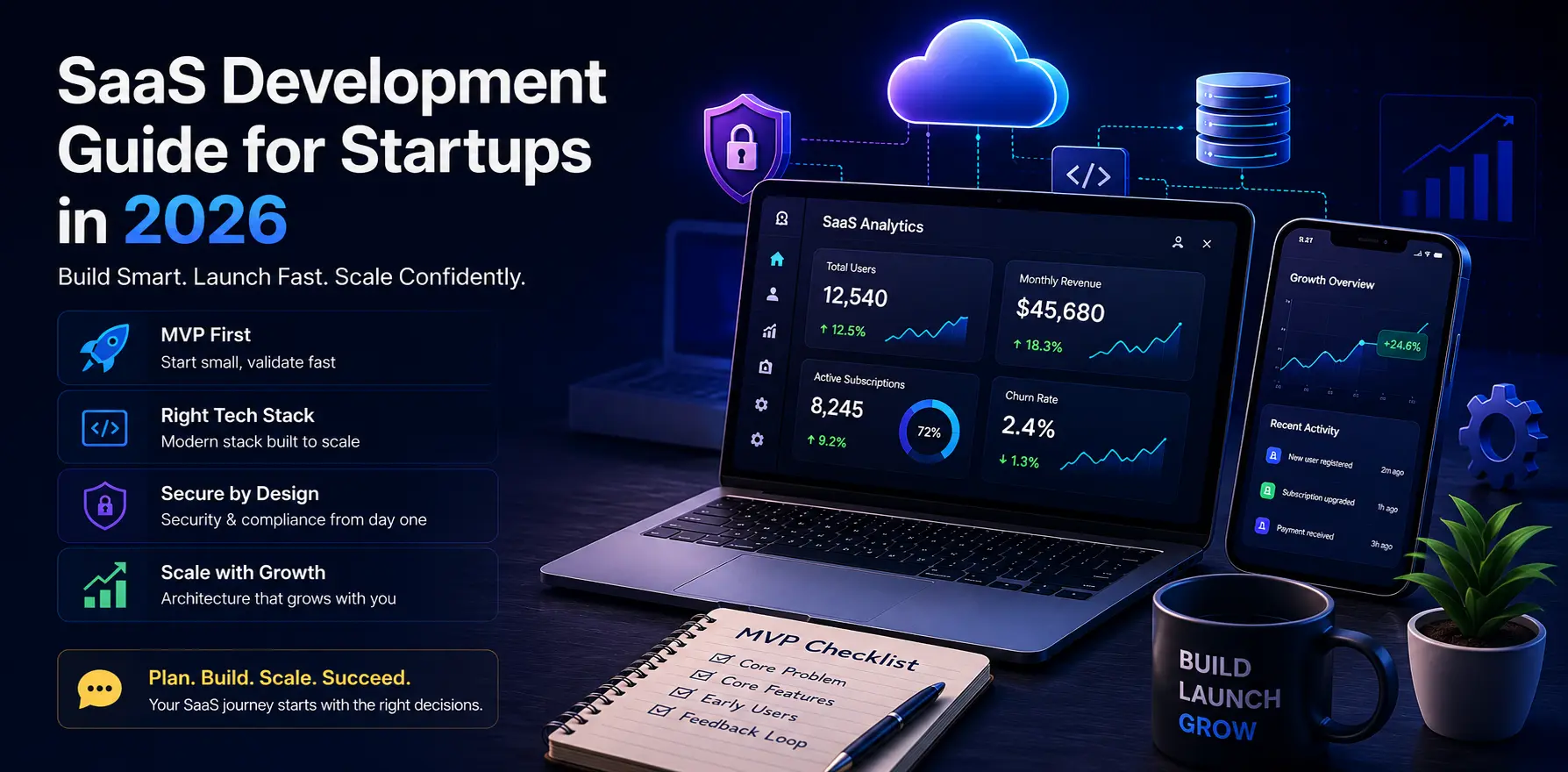
Start With An MVP, Not A Platform
The single biggest mistake early-stage founders make is building for the company they want to be in year three. Your first version needs to do one job for one type of user, well enough that they'd be annoyed to lose it.
A useful test: if you removed a feature from your MVP scope and the product still solves the core problem, remove it. Ship the smaller thing, put it in front of 20 real users, and let their behaviour (not their opinions) tell you what to build next. Feature requests are cheap. Usage data is honest.
This is also where your development partner's process shows. A good team will push back on scope. A bad one will quote you for everything you asked for.
Choosing Your Tech Stack
The right stack for a SaaS startup in 2026 is the one your team can hire for, scale with, and debug at 2 am. For most products, that means:
- Frontend: React or Next.js, with React Native or Flutter if you need mobile apps from the same team
- Backend: Node.js or Python, depending on whether your product leans real-time or data/AI-heavy
- Database: PostgreSQL as the default, with Redis for caching
- Infrastructure: AWS, Azure, or GCP with containerised deployments, so you're not locked into one vendor's pricing
Exotic stacks impress engineers and scare investors. Boring, proven technology ships faster and hires easier. Save the experimentation for features, not foundations.
How Long Does It Take To Launch
A focused SaaS MVP takes 12 to 16 weeks with an experienced team: 2 to 3 weeks for discovery and UX, 8 to 10 weeks for development, and 2 to 3 weeks for testing and launch prep. A full v1 product typically runs 5 to 8 months.
If a team quotes you 4 weeks for an MVP, they're skipping discovery, and you'll pay for it in rework. If they quote 12 months, the scope is bloated. Anything in between, ask to see the sprint plan.
Mistakes That Kill Early SaaS Products
After the launch, most failures trace back to decisions made before a single line of code:
- No pricing model until launch. Pricing shapes architecture. Usage-based billing, for example, needs metering built in from the start.
- Skipping design. Users churn in the first session if the product feels stitched together. UX is retention infrastructure.
- Building without talking to buyers. Ten customer conversations before development will save you ten sprints after it.
- Ignoring onboarding. The gap between signup and first value is where SaaS products die. Design that path as carefully as the features.
How Delaine Can Help
Delaine Technologies has spent over a decade building software products for founders and enterprise teams across India, the Middle East, Europe, and North America. For SaaS startups specifically, we handle the full build: product scoping, UI/UX design, web and mobile development, cloud architecture, and post-launch support.
Our process is built around the MVP-first approach this guide describes. We help you cut scope to what validates the business, ship it in weeks instead of quarters, and architect it so scaling doesn't mean rebuilding. You get clear timelines, honest pushback on scope, and a team that has already made the mistakes you're trying to avoid, on someone else's product.
If you're weighing what your SaaS idea would cost or how fast it could launch, talk to us. A scoping conversation is free, and you'll leave with a clearer plan either way.
Closing Lines
Build small, price early, pick boring technology, and get real users on the product before month four. The startups that win in 2026 aren't the ones with the biggest feature list. They're the ones who learned fastest.
Talk to Delaine's SaaS development team and get a clear scope, timeline, and cost estimate for your product idea.